The packet is not one document
What agents call the disclosure packet is a pile: the seller’s own disclosures, a pre-inspection if the seller ordered one, a termite report, natural-hazard disclosures, the preliminary title report, the HOA packet if there is an association, and later the appraisal and your own inspection. Each was written by a different party for a different reason. None of them was written for you to compare against the others. That comparison is the whole job.
The seller’s disclosures
The transfer disclosure and the property questionnaire are the seller answering, under signature, what they know. Read them for what is admitted: the leak that was repaired, the addition that was done without a permit, the neighbour dispute. Read them just as carefully for what is vague. “Roof age: unknown” is a fact about the seller, not the roof.
The pre-inspection
If the seller ordered an inspection before listing, it is the most useful document in the pile and the one most worth reading twice. It is also the seller’s inspector. Note the date and note what was recommended versus what was done.
The termite report
Two sections matter: what was found, and what the inspector could not access. Section 1 findings are active infestation or damage. The inaccessible areas list is where the surprises live.
The HOA packet
The rules, the finances, and the minutes. The reserve study tells you whether the association has saved for the roof it shares with forty other owners. The minutes tell you what the board is arguing about, which is usually the thing that becomes a special assessment.
Where the documents contradict each other
The roof is the classic case. The seller’s disclosure says it was replaced in 2018. The pre-inspection says it appears to be ten to fifteen years old. The appraisal, weeks later, calls it original. Three documents, three ages, and the one that becomes your budget is whichever you happened to read last.
This is why Eave for Buyers keeps a facts ledger instead of a single field. Each document’s claim is kept with where it came from, and when two disagree about something material you get a “Needs a decision” item, never a silent overwrite. When a newer version of a document arrives, both are kept and what changed is shown.

What a read is
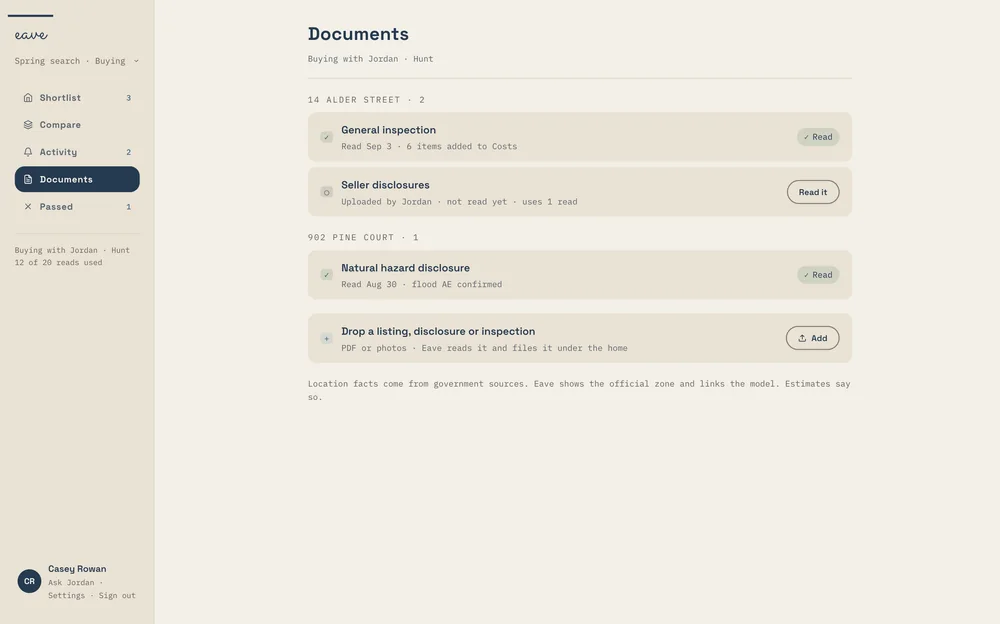
Eave sorts 46 kinds of document and reads the ones you ask it to, pulling out the dates, ages, and conditions onto the candidate. A read is metered, two per home while you look and ten in escrow, so you always know what has and has not been read. Originals are kept, and the documents belong to you at close.
Start with the house you can’t stop thinking about. Eave for Buyers pulls these facts for every home you add, sourced and dated. Free for three homes, in any browser.
Start your search →