Products
Residential · for homeowners Buyers · before you own it Commercial · for businesses & nonprofits Partners · for pros & agents
Add-ons
Guardian · protection, coming soon Pro · home concierge
Explore
Features Pricing
Resources
Guides Support Getting started Data & privacy About Sign in Start free →

Support · Buying a home

Buying with Eave: estimates, documents, fair housing

What a cost range is and is not, what happens to the seller’s documents, and the two lines Eave will not cross.

Eave for Buyers reads a lot of paper on your behalf and puts a rough number on things. This article says plainly what that number is and is not, what happens to the seller’s documents, and the two lines Eave will not cross: it never rates a school or a neighbourhood, and it never reads a listing you did not hand it.

Not an inspection or appraisal

Every cost you see in Eave for Buyers is a range from walk-through photos, the documents on the candidate, and a curated table of typical repair costs by category, size, and region. It is there to help you decide which house to offer on, not to replace the people who stand in the house. Rough ranges from photos and documents. Not an inspection. Not an appraisal. Get both before you buy.

How estimates are made

A photo or a note becomes an update item with a category and a size. The range comes from the regional table for that category and size. The model decides which band a finding falls into; it never invents a dollar figure. Each range carries a confidence and the evidence behind it, so you can see why the number is what it is and disagree with it.
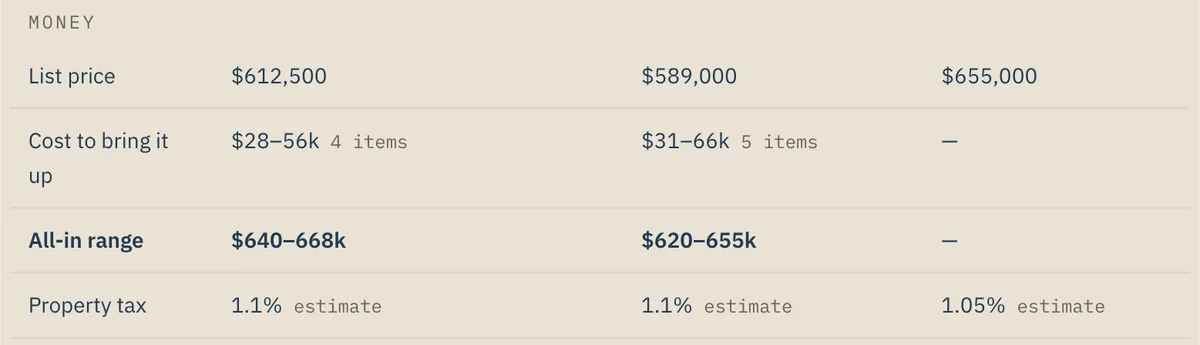
Compare · Money
Compare money rows: list price, cost to bring it up as a range with item counts, all-in range, property tax estimate
Ranges, never a single number, with the item count behind each one.

What we do with the seller’s documents

A document you or your agent puts on a candidate stays on that candidate. Eave reads it only when you ask, and every read is metered so you always know what has been read. Originals are kept. A newer version of the same document replaces the old one for facts, both are kept, and what changed is shown. When two documents disagree about the same fact, you get a decision to make, never a silent overwrite. At close, the documents for the home you bought move into its Purchase folder; the rest archive with the search. Deleting a document erases it.
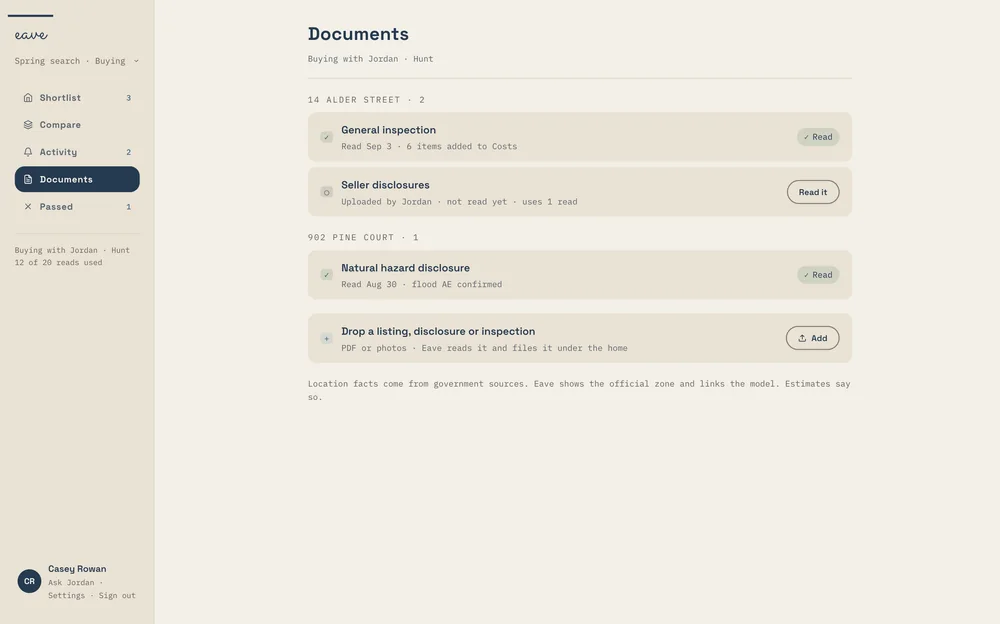
app.eavehome.app
Documents on a search with read status
Read only when you ask. Every read counted.

Fair housing

Eave shows the school district a home is zoned into, by name, with a link to the district’s own site. It does not rate schools, neighbourhoods, or people, and it never will. Flood, fire, and seismic show the official government zone with its source and date, never a vendor’s score presented as a fact. Read the full statement.

Listing material

Eave reads what you give it: an address, a listing link you paste, the PDF your agent emailed, a photo. There is no MLS feed and no scraping. The facts about the ground and the county come from public sources, independent of any listing service.

Common questions

Quick answers

Is Eave’s cost estimate an inspection?

No. Eave’s estimates come from walk-through photos, the documents you or your agent share, and a curated table of typical repair costs by category, size, and region. Not from a licensed inspector standing in the house. Rough ranges from photos and documents. Not an inspection. Not an appraisal. Always get a licensed inspection before you rely on a number to make an offer.

How does Eave come up with a cost range?

Eave never invents a dollar figure. A photo or a note is matched to a category (roof, HVAC, plumbing) and a size, and the range comes from a curated table of real repair costs for that category, size, and region, reviewed on a schedule. The model decides which band a finding falls into. It never picks the number itself. Every range comes with the evidence behind it: the photo, or the document it was read from.

What happens to the disclosure package once we upload it?

Eave reads it to pull out facts (dates, conditions, ages, disclosures) and files the document itself so you have it later. Originals are always kept; nothing is deleted or altered. If a later version of the same document arrives, Eave keeps both and shows you what changed. Documents on a search belong to the buyer. When a search closes, they carry straight into that buyer’s Eave home.

Does Eave rate schools or neighbourhoods?

No. Eave shows the school district your candidate home is zoned into, by name, with a link to the district’s own site, and nothing more. Eave never rates, scores, or characterises a school, a neighbourhood, or the people in it, and never will. This is a fair-housing commitment, not a feature we have not gotten to yet. Our fair-housing statement →

Does Eave pull listings from the MLS?

No. Eave reads what you give it: a listing link you paste, or the PDF your agent sends you, and nothing else. There is no live MLS feed and no scraping. The location facts (flood zone, school district, tax rate, and so on) come from public government sources, independent of any listing service.

Who can see my notes?

Your notes on a candidate are private by default. You can share a single note with your agent. Your agent’s fee never buys your notes, and the search is your data at close.

More on buying

Keep reading

Something still unclear? Write to support@eavehome.app and a person will answer.