Products
Residential · for homeowners Commercial · for businesses & nonprofits Partners · for pros & agents
Add-ons
Guardian · protection, coming this fall Pro · home concierge
Explore
Features Pricing
Resources
Guides Support Getting started Data & privacy About Sign in Start free →

Features · Connected Sources

Your home's history already exists.
It's just scattered.

The receipt for the water heater is in your inbox. The manual is in a drawer. The inspection report is a PDF you haven't opened since closing. The data plate is on the side of the furnace where nobody reads it. Eave pulls from all of it — connected accounts you link once, and the photos, documents, and receipts you hand over directly. Read-only where it connects. Nothing saves until you review it.

Connected accounts

Link an account once.
Eave keeps reading it.

A connected account is anything Eave reads on your behalf after you authorize it. You link it one time and it keeps working in the background — no re-uploading, no forwarding emails to yourself.

Live today
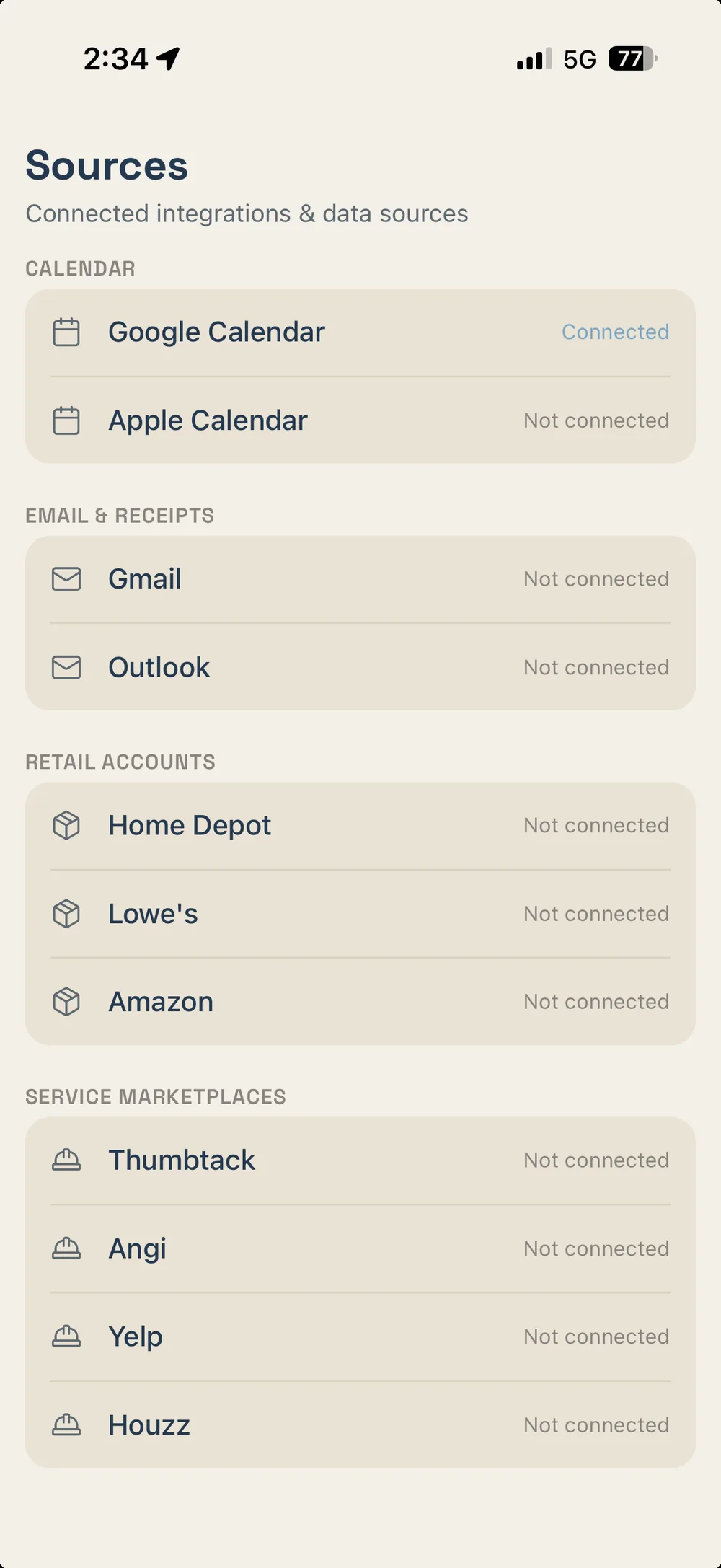
  • Gmail — home receipts, warranty registrations, and service confirmations, surfaced out of everything else
  • Calendar — contractor appointments, service visits, and inspection dates
Coming
  • Store accounts — Home Depot, Lowe’s, Amazon, for purchase history straight from the source
  • Smart-home connections — read-only device and equipment details, never control

We list the second group as coming because it is. When store accounts land, a filter you bought in March shows up attached to the furnace it fits, without you doing anything. Until then, a receipt in your inbox gets you the same result.
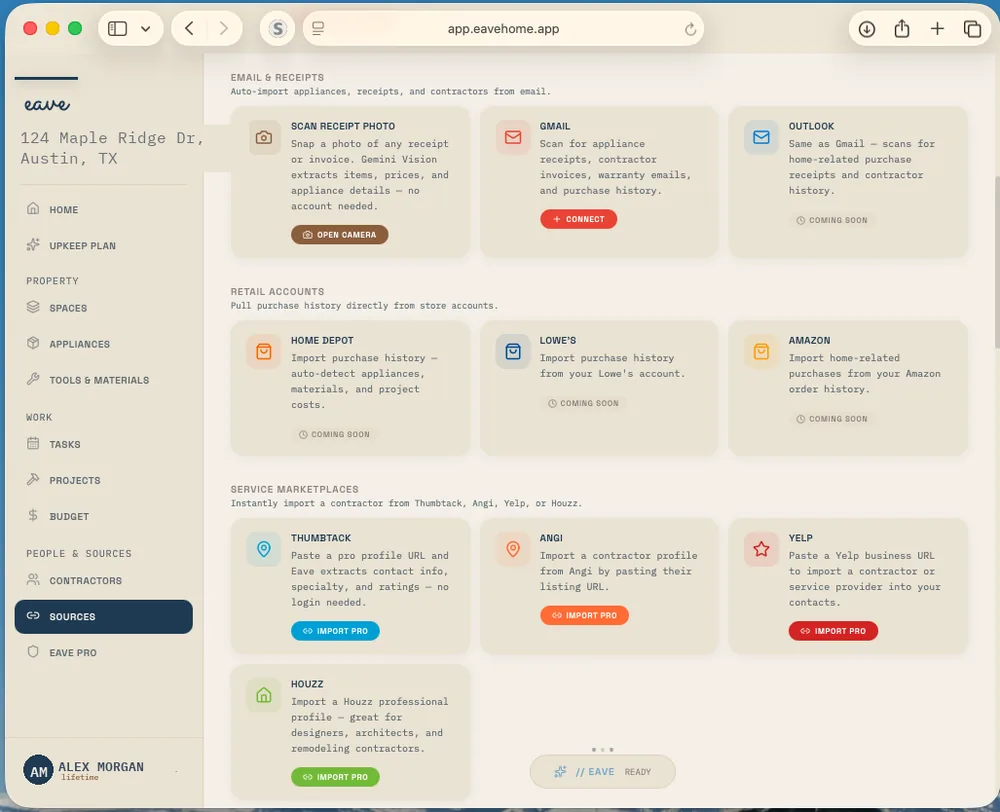
Eave connected sources on desktop showing linked accounts and the home items found in them

Connected sources on the desktop app: link an account once, and Eave keeps surfacing the home items in it.
Local sources

Some things only you have.
Hand them over once.

No inbox holds the model number stamped on the back of your dishwasher, and no account knows what the crawl space looks like. Local sources are the things you supply directly. Most take seconds, and each one you add makes the rest of the record more useful.

  • Photos of data plates — snap the sticker on the furnace, water heater, or AC unit and Eave reads the make, model, and serial off it
  • Photos of rooms and equipment — a walk-through builds the shape of the house: what’s in each room, what condition it’s in, what’s due for attention
  • Documents — inspection reports, appliance manuals, warranty paperwork, insurance declarations, HOA rules, permits, contractor quotes
  • Receipts — a photo of the paper one, or a PDF, matched to the appliance or repair it belongs to
  • Voice and text capture — say “replaced the disposal, Badger 5, $340” and it lands in the record; type it if you’d rather

Local sources are free, and they stay free. Capturing what you own is memory, not intelligence — we don’t charge you to write down your own house.

Eave on a phone showing home items found from connected and local sources, awaiting review

On mobile, Eave surfaces what it found from every source — each item waiting for your review.

Inspections and disclosures

You paid for the inspection.
Don’t let it die in a PDF.

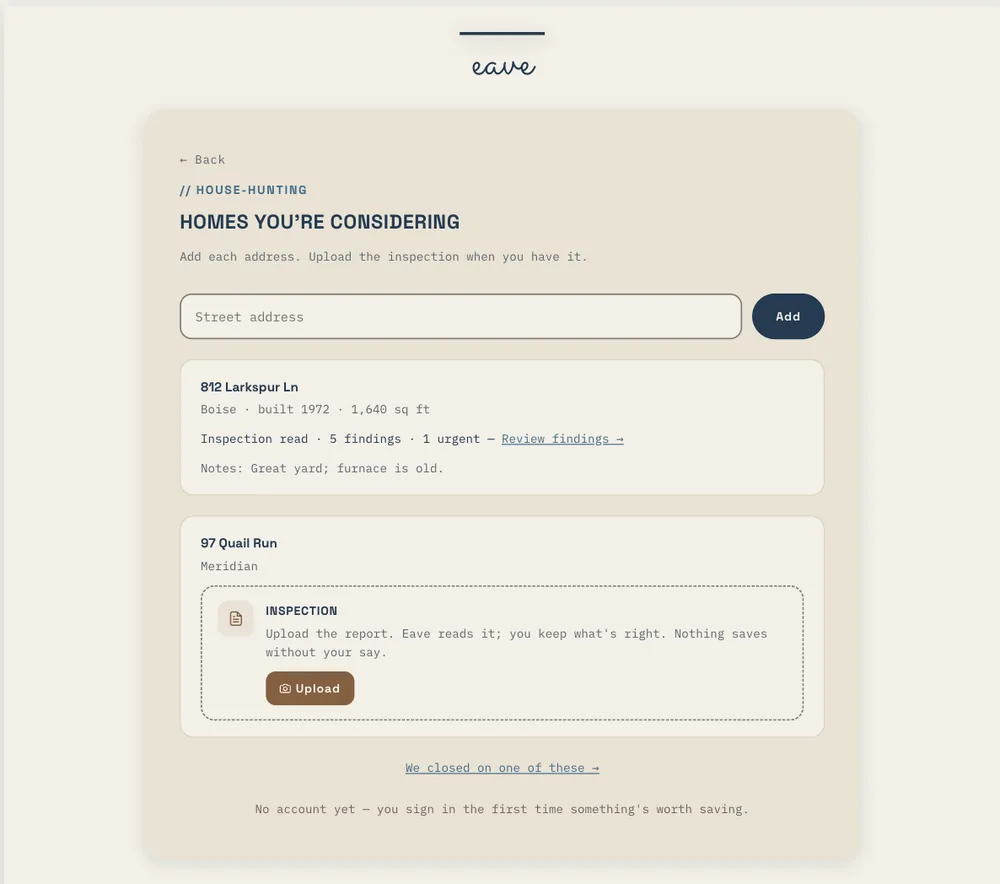
A home inspection report is the densest record of your house that will ever exist — usually forty pages, usually read once, usually filed and forgotten. Disclosure documents are the same story from the other direction: what the last owner knew, written down and then abandoned. Upload either one and Eave takes it apart.

What Eave pulls out of an inspection report
  • Systems — the roof, furnace, water heater, panel, and the rest, with install year and condition as the inspector recorded them
  • Findings — each issue the inspector flagged, with its severity, so urgent separates from someday
  • Photos and page references — kept with the item, so you can go back to the original wording
What else is worth uploading
  • Seller disclosure statements — known defects, past repairs, and what was never fixed
  • Permits and closing documents — what work was done legally, and when
  • Prior owners’ warranty paperwork — some of it transfers

This matters most at the two ends of ownership. If you’re buying, the report is your first upkeep plan, and you’re getting it at the exact moment you can still act on it. If you’re selling, the same record is the proof the house was cared for — the difference between “I think we did the roof around 2019” and a dated entry with a receipt attached.

What Eave reads

Read-only, and only your home.

Connected access runs one direction. Eave looks; it never writes, never sends, never changes anything on the other end.

The specifics of how access works and how your data is handled are on the data and privacy page, in plain terms.

You review first

Nothing saves without your say.

Every source — connected or local — lands in the same place: a review queue. Eave surfaces what it found and holds it there.

A record is only worth having if it’s accurate, and the fastest way to ruin one is to fill it with things nobody checked. Review-before-save costs you a few seconds an item and buys you a record you can trust years later.

Where it all goes

Memory is free.
The thinking is $2.99.

Everything above — connected accounts, photos, documents, receipts, voice capture — builds your home’s memory, and that costs nothing. The memory is the raw material. Eave Intelligence is what turns it into a plan.

Free, forever
  • Capture from every source, connected and local
  • Your searchable home record — rooms, systems, appliances, contractors, documents
  • Warranty dates, install years, model and serial numbers, receipts
Eave Intelligence · $2.99/month
  • Your upkeep plan — every task the record implies, scheduled against your actual equipment rather than a generic checklist
  • A ranked queue — what to do next, ordered by what it costs you to keep waiting
  • Your Upkeep Score — one number for how far ahead or behind the house is
  • Cost and risk estimates drawn from what your systems actually are, not averages

The math is the argument. The average deferred repair runs about $5,600 once it turns urgent, and 92% of homeowners are carrying at least one outstanding repair right now. Intelligence has to catch one thing to pay for a lifetime of itself. See pricing.

In practice
How do I keep track of home warranties?

The dishwasher receipt lands in your inbox and Eave notices it — purchase date, model, warranty term. You confirm it once in the review queue. Later that week you snap a photo of the data plate on the furnace while you’re down there anyway, and upload the inspection PDF from closing. Three sources, four minutes total.

That’s the memory. Turn on Intelligence and it becomes a plan: a reminder before the dishwasher warranty lapses, while a claim is still free. The furnace filter on the right interval for the model you actually own. The inspector’s note about the water heater’s age sitting in the queue with a number next to it.

Questions

About connected sources

What can I connect right now?

Gmail and your calendar. Eave surfaces the home-related receipts, warranties, and contractor confirmations already sitting in them. Store accounts like Home Depot, Lowe’s, and Amazon, and smart-home connections, are coming and are not live yet.

What if I don’t want to connect anything?

Then don’t. Everything in Eave can be built from local sources: photos, documents, receipts, and voice capture. Connecting an account saves you typing; it isn’t required.

What does Eave read from my email?

Read-only access, home items only: purchase receipts, warranty registrations, and contractor or service confirmations. It never sends email on your behalf and never changes anything in your inbox.

Does anything save automatically?

No. Everything goes to a review queue first. You decide what’s kept, what’s corrected, and where it belongs.

Can I upload my home inspection report?

Yes. Eave reads it and pulls out your systems with their install years and condition, plus every finding the inspector flagged with its severity. See importing a home inspection report.

Do I need to pay to use connected sources?

No. Capture and your home record are free. Eave Intelligence — the upkeep plan, the ranked queue, and the Upkeep Score — is $2.99/month.

Keep exploring

Where connected sources lead

See it on your own home. Eave is free for one property and runs in any browser — your first capture takes about five seconds.

Start free →