List price is half the number
Two houses, same street, one listed forty thousand below the other. The cheaper one has an original roof, a twenty-year-old furnace, and a deck the pre-inspection calls “end of serviceable life.” The expensive one was re-roofed in 2022. You are not choosing between the list prices. You are choosing between the list prices plus what each house needs to be the house you think you are buying.
Why nobody does this before the offer
Every repair estimator that exists waits for a finished inspection report, and the inspection happens after your offer is accepted. So the number you most need for the decision is the one you get after you have made it. The fix is to price the visible things from what you have: the walk-through, the pre-inspection, the disclosures, your agent’s eye.
How to do it by hand
- Walk the house with a list, not a feeling. Roof, exterior, windows, furnace, water heater, electrical panel, plumbing, kitchen, baths, deck. Note the visible age or condition of each.
- Put a range on each item, not a number. A roof on a house that size runs a band, not a figure. The band is honest; the figure is a guess in a suit.
- Sort by urgent, soon, someday. Only the first two go into the offer math. Someday is real, but it is not this year’s money.
- Add it to the list price. That is the all-in range, and it is the number to compare.
What Eave does with the same inputs
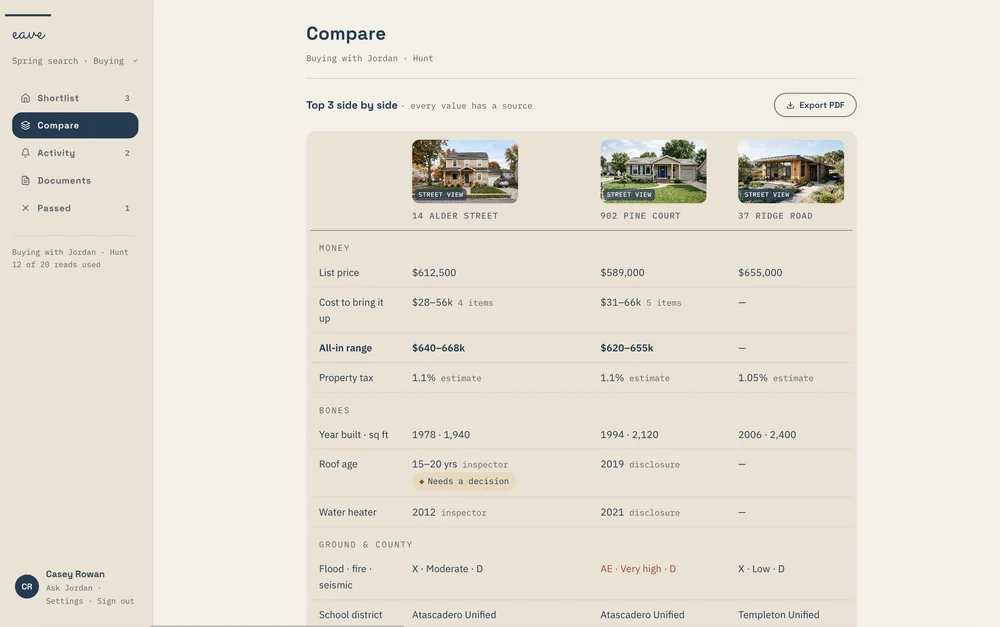
Eave for Buyers turns walk-through photos and your agent’s notes into update items, each with a category, a size, and a cost band from a curated regional table. The model decides which band a finding falls into; it never invents a dollar figure. Every band carries the evidence behind it. Compare shows the top three on list price, cost to bring it up, all-in range, and the bones of the house with their sources, and exports as a PDF you can take to the offer conversation.
What the number is not
Rough ranges from photos and documents. Not an inspection. Not an appraisal. A range from photos and documents tells you which house to look harder at. It does not tell you what the house is worth or what is behind the drywall. Get a licensed inspection and an appraisal before you rely on any number to make an offer. Then, when the inspection arrives, Eave reads it into the same candidate and the range becomes a finding.
Start with the house you can’t stop thinking about. Eave for Buyers pulls these facts for every home you add, sourced and dated. Free for three homes, in any browser.
Start your search →